.jpg)


Ueno Tourism Association OFFICAIL
上野公園とその周辺
目でみる百年の歩み3
Victory in the Sino-Japanese War

図は、不忍池に敵の旗艦定遠を浮べ、これに火をつけて祝っている。
Picture of the celebration of the occupation of Port Arthur at Shinobazu Pond in Ueno (owned by Hoshino Heijiro)
After Japan's victory in the First Sino-Japanese War, war was declared against Russia. Civilization shifted from horse-drawn carriages to electric trains. The end of the Meiji period saw a mixture of war with foreign countries, Westernization, and modernization.
From the Sino-Japanese War to the end of the Meiji era
明治26年(1893)
Tokugawa family's Renga Hajime ceremony held at Toshogu Shrine
01.11
Lieutenant Colonel Fukushima Yasumasa returns to Japan after crossing Siberia alone, with a large welcome party held at Ueno Park for the return of the Japanese.
06.29
The Ministry of Education designates "Kimigayo" as the national anthem
08.
1894 (27th year of the Meiji era)
The Sino-Japanese War begins
07.25
A victory celebration is held at Shinobazu Pond in Ueno Park.
12.09
"Records from these days"
・The total cost of the Sino-Japanese War was 230 million yen
・The national budget for the year before the war was 260 million yen

The Dingyuan's sister ship, the Zhenyuan, was captured and its anchor was displayed at the site of the former horse viewing station at Shinobazu Pond (around the center of the current water zoo).

上野公園で開かれた戦勝祝賀会

The bronze statue of Saigo Takamori (owned by Hoshino Heijiro) quickly became a famous landmark in Tokyo after its unveiling.
1895 (28th year of the Meiji era)
Shinobazu Pond Bamisho auction due to road improvement
02.01
Treaty of Shimonoseki signed, Sino-Japanese Peace Treaty
04.
Approval was made to lay a horse-drawn railway between Ueno and Asakusa.
10.31
Prince Kitashirakawa Kanehisa (former Rinnojinomiya) dies of illness, state funeral held on the 11th
November 15
1896 (29th year of the Meiji era)
Celebration of the 100th anniversary of Siebold's birth held at Ueno Seiyoken
02.17
A memorial service for the Taiwanese war dead is held at Shinobazu Pond.
04.25
Ueno Sannodai selected as site for construction of Saigo Takamori's bronze statue
05.14
Panorama Hall opens in Sakuragaoka
08.12
1898 (Meiji 31)
Internal disputes at Tokyo School of Fine Arts lead to Okakura Tenshin's resignation as principal
03.
Celebration of the 30th anniversary of the capital's establishment held at Ueno Park
04.10
Okakura Tenshin founded the Japan Art Academy
07.
Tokyo City Hall opening ceremony held at Ueno Park
November 13
Bicycle races become popular around Shinobazu Pond
11.
The unveiling ceremony for the bronze statue of Saigo Takamori is held.
12.18
1899 (32nd year of the Meiji era)
First High School students hold a 13-mile race at Shinobazu Pond.
05.13
1900 (Meiji 33)
The Japanese Railway Company built a new waiting area (Western restaurant, tea shop, confectionery shop, etc.) in front of Ueno Station.
08.
上野駅に公衆電話機を設ける。十銭、五銭各一個を投入使用
09.01
1901 (34th year of the Meiji era)
The Great Japan Martial Arts Tournament in Memory of Yamaoka Tesshu is held at Takenodai
10.20
Autumn cycling event held at Shinobazu Pond
10.20
The opening ceremony for the telegraph company is held at Ueno Seiyoken.
11.07

The modern sport of bicycle racing became popular along the banks of Shinobazu Pond, following horse racing.

Ueno Zoo has also taken on a dignified appearance.

Cherry blossom viewing scene from the mid-Meiji period (owned by Kitagawa Chikayuki)

In front of Ueno Park (mid-Taisho period) where horse-drawn carriages were replaced by electric trains
1902 (Meiji 35)
The 650th anniversary of the founding of Nichiren Buddhism is celebrated in Ueno Park.
04.28
Red Cross 25th Anniversary Celebration Held at Ueno Park
10.21
1903 (Meiji 36)
Streetcar service opens between Shinbashi and Ueno, with a flat rate of 3 sen.
11.25
1904 (37th year of the Meiji era)
Declaring war on Russia
02.10
Train service begins between Ueno and Asakusa, horse-drawn carriages disappear from Tokyo city
03.18
1905 (38th year of the Meiji era)
Celebrations held at Ueno Music School to commemorate the 50th anniversary of Ninomiya Sontoku's death
11.26
A grand welcome party for the Army is held by Tokyo citizens in Ueno Park.
12.17
1906 (39th year of the Meiji era)
New Ueno Imperial Library completed
03.20
The Kanto Eight Provinces Association's Grand Horse Racing Association will be held on the banks of Shinobazu Pond for the first time in 15 years.
05.19
Japanese Red Cross Society holds memorial service for nurses who died in the Russo-Japanese War at Mount Suribachi in Ueno
06.10
A demonstration of the language gramophone was held at Ueno Seiyoken.
09.0
Construction work to cover the Shinobu River, commonly known as Dondon, has begun. Due to the congestion at the Tokyo Expo
12.15
市電値上反対で電車焼打事件起る
09.
"Records from these days"
Train fare before the 1906 train burning incident.
・5:00 AM to 7:00 AM
One-way toll tax: 3 sen, round trip tax: 5 sen
After 8:00 AM, the normal round-trip toll is 9 sen

A horse-drawn railway passing in front of Ueno Park in the mid-Meiji period. The road lines are traces of water being poured over them.

With the outbreak of the Russo-Japanese War in 1894,
Tobacco, which was the star of the business at the time, became a monopoly.
Just before that, Iwatani Shokai, well-known for its Tengu cigarettes, watered Ueno Park to appeal to the public for their spirit of service.

In 2000, the first national library specializing in children's books was established.
The National Diet Library opens as the International Children's Library.
(Added in 2011)
Ueno Library boasts the largest collection of books in Japan, at 1 million volumes, and has nurtured many intellectuals.
Currently the Ueno Branch of the National Diet Library.
Tokyo Industrial Exposition
Because the venue was so large that it was impossible to see everything in one day, tickets were sold in sets of three for 10 sen, and night-time admission tickets were also sold.
New attractions always appear at the exposition. At this time, the Ferris wheel in the first hall and the water slide in the second hall were popular.


Tokyo Industrial Exposition admission ticket (owned by Hoshino Heijiro)
Water chute at the second venue of the Tokyo Industrial Exposition
1907 (40th year of the Meiji era)
Iwakura Railway School burns down
03.07
Tokyo Industrial Exposition held at Ueno Park (until the end of July)
03.20
The first Ministry of Education-sponsored art exhibition (Bunten) is held in Ueno Park.
10.25
帝室博物館、宮内大臣の所轄となる。
10.31
1908 (41st year of the Meiji era)
Ueno Kuromon Gate was relocated to Sannowa Entsuji Temple.
Due to road repairs in September 1869, it was moved from Kuromon Gate to the side of Toshogu Shrine, and then to the side of Ryodaishi, but at the request of Entsu-ji Temple, it was donated by the Imperial Museum.
05.17
Models at Ueno Art School go on strike.
11.04
"Records from these days"
・One sho of rice: 12 sen
・There are 47 people who own their own car in Tokyo
・Benz 17,000 yen
・Blade Ater (motorcycle) 1,000 yen
・For cars with four or more cylinders, the price is 4,000 yen or more.

Ferris wheel at the first venue of the Tokyo Industrial Exposition

The Kuromon Gate when it was moved to the side of Toshogu Shrine in 1871

Year-end gift sales at Matsuzakaya Ueno store, which was renovated in 1907
From Tokugawa Town to Cultural Center Town
The most notable thing about Ueno during the Meiji period was that it transformed from a temple town into a cultural district. Once the base of the Tokugawa shogunate, it was reborn as a public space, a park. Educational and cultural facilities such as museums and zoos were built in the park, and the government and the city of Tokyo brought all kinds of events to Ueno Hill.
This is where the direction of the Ueno area was determined, and it was decided that it would become the central entertainment district of Tokyo with a park.

左)「表慶館」開館、国立博物館構内にあり、考古学資料が展示されている。
右)上野動物園に来たアフリカ産の河馬。
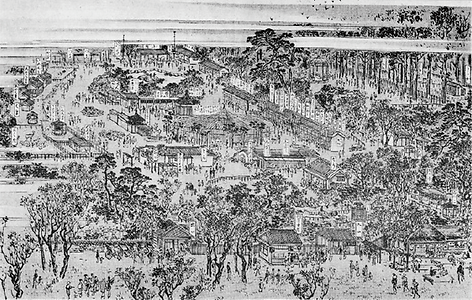
A panoramic view of Ueno Zoo in the mid-Meiji period (from Shinsen Tokyo Meisho Zue)
1909 (42nd year of the Meiji era)
The 20th anniversary of the promulgation of the Constitution is celebrated in Ueno Park.
02.11
Hyokeikan opens on the grounds of the Imperial Museum.
It was built with 400,000 yen in donations to celebrate the Crown Prince's marriage.
02.22
Train service begins on the Yamanote Line (between Ueno, Yoyogi, Tamachi, and Torimori)
12.16
下谷区役所、上車坂三十一番地正法院跡に移転。
12.
1910 (Meiji 43)
Heavy rains flooded approximately 6,000 homes in Shitaya Ward and 14,000 homes in Asakusa Ward
08.11
1911 (44th year of the Meiji era)
Tokyo School of Fine Arts burned down
01.25
African hippopotamus makes first appearance at Ueno Zoo
05.
1912 (Meiji 45)
Unveiling of the bronze statue of Prince Komatsu Akihito
03.18
Emperor Meiji passes away and the era name changes to Taisho.
07.30
Uguisudani Station opens in Ueno Sakuragicho
07.
The Colonization Exposition was held at Shinobazu Pond. Taxis appeared in Tokyo this year.
10.01
"Records from these days"
・Tokyo city population: 1,620,000
・830,000 people from inner regions
・20,286 single-seater rickshaws
・258 two-seater vehicles
・Rental rickshaws: 3,923 units
・2,025 pawn shops
・753 inns
・1,664 lodging houses
・529 lodging houses
・Geisha 4,088 people
・Prostitutes 4,300 people
・4,000 private prostitutes in Asakusa
(commonly known as Twelve Floors Below)


On the far left, you can see the Ryumon Bridge monument currently located on the south side of Shinobazu Pond.

(Collection of Kitagawa Toshiyuki)
The same scene as the photo above, from the great flood of August 1910 (near Ueno 7-chome)
In those days, the overhead pole was in the middle, with trains running on both sides.

Bronze statue of Prince Komatsu Akihito, the first chairman of the Japanese Red Cross Society (center of Ueno Park)