.jpg)


Ueno Tourism Association OFFICAIL
Ueno Park and its surrounding areas
A visual journey of 100 years 5
From the start of World War II to its end. The continuation of reconstruction following the Great Taisho Earthquake. The beginning of the turbulent Showa era.
From the early Showa period to the end of World War II
In 1927, the first subway in the Orient was opened.
It was a modern ticket gate where the entrance opened automatically when you inserted the fare.
The Showa Era War and Peace
─The blue bird I was searching for─
The Showa era began before Japan had even fully recovered from the Great Taisho Earthquake. While the rate of recovery was remarkable, World War II once again reduced Tokyo to ashes. The losses of the war were not only material but also psychological, many times greater than those of the earthquake. Eventually, the war ended, ushering in a democratic era known as the Showa Renewal. It was as if we had finally found the blue bird we had longed for.
This new era has arrived in the town of Ueno. However, it has not been without its challenges. There have been many social problems, such as vagrants, street thugs, women of the night, and black markets. However, we have not given in to the difficulties and have proactively dealt with these problems, achieving the prosperity we enjoy today.

1927 (Showa 2)
Japan's first subway opens between Ueno and Asakusa
12.30
1928 (Showa 3)
A citizens' rally to denounce the city government will be held at Ueno Community Center.
09.16
A grand celebration for the enthronement was held in Ueno Park, attended by the Emperor and Empress.
November 13
1930 (Showa 5)
Subway service opens between Ueno and Manseibashi.
01.01
New Ueno Library building completed
03.16
Sea and Sky Expo opens in Ueno Park
03.
His Majesty the Emperor toured the restored Tokyo
You can see the city from in front of the bronze statue of Saigo Takamori.
03.24
An underground passage has been completed in front of Ueno Station.
04.01
《 この頃の記録 》
Tokyo land price per tsubo
・Ginza Main Street 1,756 yen
・Ueno Hirokoji 900 yen
・Asakusa Kaminarimon 800 yen
・Near Yurakucho Station: 600 yen
・Shinjuku Main Street 349 yen
京成電鉄、環境保全に全力
At this time in 1933, in order to preserve the environment of Ueno Park, open-cut mining was carried out under the road, but work was carried out by digging through the woods under the road, and horseshoe-shaped bricks were laid to prevent rockfalls.

The open-cut mine in front of the museum, with all the scaffolding made of logs. (Courtesy of Keisei Electric Railway)

The connection between the horseshoe and box shapes. (Courtesy of Keisei Electric Railway)
1931 (Showa 6)
The first talkie film is released.
08.01
The Manchurian Incident breaks out.
09.18
Tokyo Science Museum opens.
11.02
1932 (Showa 7)
Ueno Station building completed
04.02
May 15th Incident
05.15
Greater Tokyo City is established with 35 wards.
10.01
1933 (Showa 8)
Keisei Ueno Station to Nippori Station opens.
12.10
"Records from these days"
Prices in Tokyo in 1932
・Starting salary for university graduates: 50 yen
・Carpenter/plasterer daily allowance: 2 yen
・Young worker: 40 sen
・Meshiya set meal 10 sen
・Tea and coffee: 5 sen
・Soba and udon noodles: 7 sen
・One Daifuku mochi: 2 sen
・One piece of pork cutlet: 10 sen
・Rice curry 10 sen
・Public bath 5 sen
・Free tram transfers: 7 sen
・Ten bats, 7 sen
・One sho of foreign rice: 7 sen
- Rent for a tenement house in a slum: 3 yen
・Three-part antique film for adults: 10 sen
(All average values)
Ueno Station Usage Status Annual Number of Passengers Boarding and Alighting
・1887 (20th year of Meiji) 822,899 people
・1897 (Meiji 30) 1,276,224 people
・1907 (Meiji 40) 5,404,043 people
・1917 9,656,660 people
・1927 (Showa 2) 27,817,401 people
・1937 (Showa 12) Unknown
・1947 (Showa 22) Unknown
・1957: 79,276,000 people
・1967 (Showa 42) 136,412,171 people
・1972: 153,534,191 people
(According to Ueno Station)

Scene from the Shitaya support event to commemorate the completion of the new Ueno Station building

Tokyo Science Museum opened on November 2, 1931.
It is shaped like an airplane, fitting for a science museum. (Kitagawa Tomoyuki Collection)
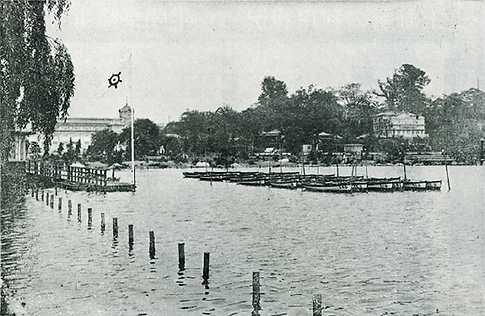
A photo taken in June 1931, when Shinobazu Pond boating pond first opened for business.
The building on the upper right of Shinobazu Pond is called the Ueno Club, a modern apartment building for the time. It is said that before the Great Taisho Earthquake, an unsuccessful poet and a student obsessed with communism lived there. These people were the future Saijo Yaso and Nosaka Sanzo.
(Sanzo Nosaka)
It was around this time that Ueno Park began to take on the dignity befitting a cultural forest.
The result is something as impressive as a museum, art gallery, or science museum.
(Tokyo Metropolitan Park Association Collection)
1935 (Showa 10)
A monument to Lafcadio Hearn stands in front of Ueno Library.
06.
Held the 60th anniversary of Emperor Meiji's visit to Ueno Park.
Ueno Nostalgia Exhibition, Shitaya Ward Industrial Development.
11.01
1936 (Showa 11)
The February 26 Incident breaks out
02.26
Train service begins between Ueno and Matsudo on the Joban Line.
12.
1937 (Showa 12)
The Marco Polo Bridge Incident occurs, and the Sino-Japanese War breaks out.
07.07
Construction of the Imperial Museum was completed and it opened in November of the following year.
11.06

Tokyo Imperial Household Museum

Former Tokyo Imperial Museum
Ueno's rock bottom, walking the hard road
1941 (Showa 16)
The Pacific War begins, and war is declared on the United States and Britain.
12.08
1943 (Showa 18)
Tokyo metropolitan government system
07.01
Ueno Zoo begins euthanasia in anticipation of wild animals being released into the wild due to air raids.
08.
1941 (Showa 16)
The Nakaokachimachi 2-chome area was burned down in an air raid.
01.01
It was burned down in an air raid near Ueno Hirokoji.
02.25
130 B29s attack, burning down the entire downtown area.
03.09
The Imperial Rescript on the Termination of the War is issued.
08.15
The Ueno Reconstruction Association was founded.
11.

An Imperial Rescript on Unconditional Surrender and War is issued (August 15, 1945).

Most of the area around Hirokoji was burned down, and there was heavy snowfall that night.
(February 25, 1952)